Impact
In recent years, the Government of Rwanda has sought to strengthen domestic revenue mobilisation through tax policy reforms, improved enforcement, streamlined administration, and greater citizen engagement to encourage compliance. Important features of this approach have been increased communication with taxpayers, the adoption of innovative technologies, and the use of real-time data to assess their impacts.
One such reform was Rwanda's early adoption of electronic billing machines (EBMs) for VAT, which improved compliance but still resulted in gaps in the issuing of invoices, particularly in transactions between businesses and consumers. This "last-mile" problem arises because consumers lack incentives to request invoices, enabling businesses to under-report their sales and evade taxes, and creating scope for collusion whereby consumers pay lower prices and businesses fail to remit VAT.
To address this, in March 2024 the Rwanda Revenue Authority (RRA) introduced a VAT Reward Programme (Tengamara na TVA), to incentivise consumers to request invoices and reduce under-reporting. This was later expanded through Tenga Promo, which incorporated lotteries and loyalty points. TaxDev worked closely with MINECOFIN and RRA on the design of the programme, providing evidence on international experience, behavioural incentives, and cost-effectiveness that informed key design decisions. By mid-July 2025, more than 120,000 consumers had registered for the programme, and the number of traders registered to use EBMs increased by around 25% over a one-year period.
As of 2025, at least 44 countries have experimented with consumer incentive schemes for tax compliance, including lotteries, VAT rebates, personal income tax deductions, and whistleblowing mechanisms. In addition to potential revenue gains, these schemes aim to increase the volume and accuracy of invoicing, encourage the adoption of digital technologies, strengthen tax morale and accountability, and support formalisation.
While the evidence indicates that compliance may improve when enforcement is complemented by behavioural incentives, effectiveness is very sensitive to design. Incentives need to be sufficiently salient and attractive to consumers, efficient and low-cost to administer, and fiscally sustainable. Getting the design right therefore required careful upfront analysis rather than simply replicating approaches used elsewhere.
In partnership with MINECOFIN and RRA, TaxDev worked on early-stage conceptualisation and analysis of potential policies, including an appraisal of potential costs and benefits drawing on lessons from international practice. The appraisal found that modest rewards for consumers could generate incentives to request invoices and be fiscally sustainable, depending on the fine details of design: how convenient it is to register and participate; how the programme is communicated to maximise participation; how fiscal risks are internally managed; and how to allow adjustments based on market reactions.
These findings helped shape the design parameters for Rwanda's VAT Reward Programme, ensuring that incentives could influence behaviour without creating disproportionate revenue risks. TaxDev's work also emphasised the importance of technological integration — ensuring that electronic billing and reward distribution could be automated, transparent, and easily monitored.
Tengamara na TVA launched nationally in March 2024. Consumers who request EBM invoices receive a 10% VAT refund, and if a trader refuses to issue an invoice, the consumer is entitled to 50% of the resulting fine. In 2025, RRA introduced Tenga Promo, adding loyalty points and automatic entry into a weekly lottery to further encourage participation.
According to the RRA, by mid-July 2025:
Over the same period, VAT collections rose from Rwf 792.0 billion in FY 2023/24 ($546 million / £418 million) to Rwf 925.8 billion in FY 2024/25 ($638 million / £488 million), with VAT revenues reaching 103.8% of the annual target. Multiple factors influence VAT performance, but these trends could be consistent with improved invoice issuance and reporting.
By turning tax compliance into a tangible benefit for citizens, the Government also hopes to build a culture of voluntary compliance and strengthen the broader social contract.
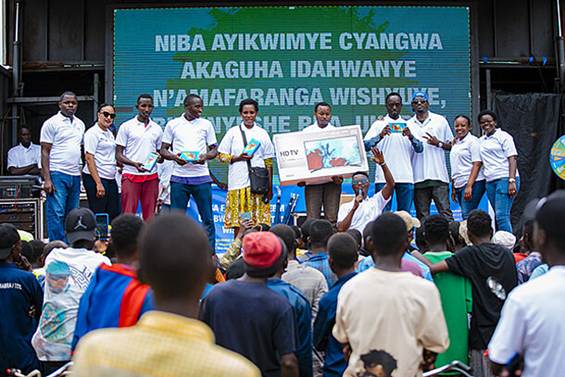
Photo: Rwanda Revenue Authority
The programme is still young, but a few things stand out so far:
The long-term sustainability of the programme will depend on maintaining a favourable balance between the cost of incentives and additional revenue generated, and will need to be regularly monitored. Over time, if requesting invoices becomes an established norm, the reliance on financial incentives may be reduced while compliance gains are maintained.
Published on: 2nd October 2026
Print